


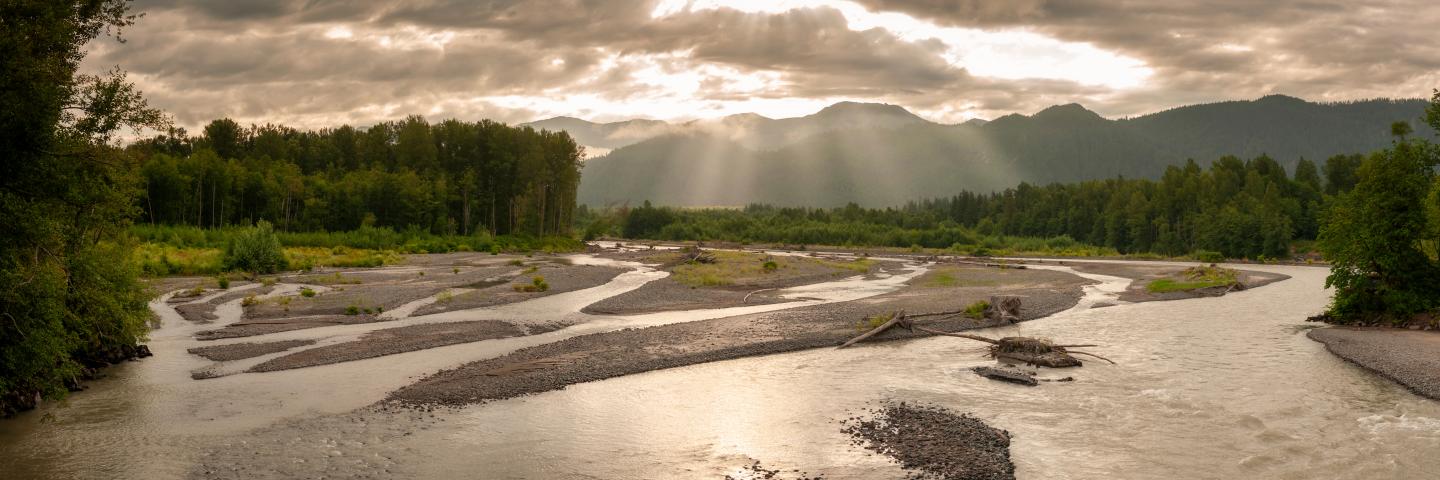
Watersheds impact everyone; every community, farm, ranch, and forest. They provide a vital resource for all living things to survive and thrive. All watersheds are interconnected, creating a land-water system that conveys water to its final destination such as a river, lake, wetland, or estuary.
NRCS Watershed Programs provides technical and financial assistance to local government agencies, tribal organizations and other eligible sponsors, to help communities implement conservation practices that address watershed resource concerns.
Watershed Programs in Arizona

Emergency Watershed Protection (EWP) Program
The Emergency Watershed Protection (EWP) Program is focused on reduction of hazards to life and property caused by sudden natural disasters and can involve technical and/or financial assistance. Threats that the EWP addresses are called watershed impairments. These include, but are not limited to:
- Debris-clogged waterways.
- Unstable streambanks.
- Severe erosion jeopardizing public infrastructure.
- Wind-borne debris removal.
- Damaged upland sites stripped of protective vegetation by fire or drought.
Project funds address erosion and flooding related watershed impairments by supporting activities such as removing debris from stream channels, reshaping and protecting eroded banks, and reseeding damaged areas.
View the list of Current EWP Projects in Arizona.
Learn more about the EWP program by visiting the national program page.

Watershed Rehabilitation
The Watershed REHAB program provides assistance to local project sponsors to:
- Rehabilitate aging dams that are reaching the end of their design lives; and/or
- Build or augment existing water supplies based on current and future water supply demands.
These rehabilitation efforts, authorized by Public Law 83-566 and 78-534, address critical public health and safety concerns should a dam failure occur.
View the list of Current Watershed REHAB Projects in Arizona.
Visit the national program page for more information.

Watershed and Flood Prevention Operations
The Watershed Protection and Flood Prevention (WFPO) program provides technical and financial assistance to states, local governments and Tribal organizations to help plan and implement authorized watershed projects for the purpose of:
- Flood Prevention
- Watershed Protection
- Public Recreation
- Public Fish and Wildlife
- Agricultural Water Management
- Municipal and Industrial Water Supply
- Water Quality Management
Watershed conservation projects are planned and carried out jointly by local, state, and federal agencies with the support of community landowners and citizens in the watershed. Communities identify resource problems to be addressed, practices to be installed, and carry out major portions of a watershed plan, such as obtaining easements, rights of ways, permits and local cost-share funding.
All Watershed Program projects must have a local sponsor that can act as the fiscal agent, provide project management and oversight throughout the different phases of construction, implementation, and project lifespan.
A Preliminary Investigation Findings Report (PIFR) is the first step in the WFPO process.
The purpose of the Preliminary Investigation Findings Report (PIFR) is to provide reasonable assurance that a feasible plan can be developed that addresses resource concerns in a watershed under one or more Public Law 83-566 authorized purpose, and that there are no apparent insurmountable obstacles. The PIFR is the justification document for the State Conservationist to request Watershed and Flood Prevention Operations (WFPO) funding.
Learn more about the PIFR process.
View the list of Current WFPO Projects in Arizona.
Visit the national program page for more information.
Ready to get started?
Contact your local service center to start your application.
How to Get Assistance
Do you farm or ranch and want to make improvements to the land that you own or lease?
Natural Resources Conservation Service offers technical and financial assistance to help farmers, ranchers and forest landowners.

To get started with NRCS, we recommend you stop by your local NRCS field office. We’ll discuss your vision for your land.
NRCS provides landowners with free technical assistance, or advice, for their land. Common technical assistance includes: resource assessment, practice design and resource monitoring. Your conservation planner will help you determine if financial assistance is right for you.
We’ll walk you through the application process. To get started on applying for financial assistance, we’ll work with you:
- To fill out an AD 1026, which ensures a conservation plan is in place before lands with highly erodible soils are farmed. It also ensures that identified wetland areas are protected.
- To meet other eligibility certifications.
Once complete, we’ll work with you on the application, or CPA 1200.
Applications for most programs are accepted on a continuous basis, but they’re considered for funding in different ranking periods. Be sure to ask your local NRCS district conservationist about the deadline for the ranking period to ensure you turn in your application in time.
As part of the application process, we’ll check to see if you are eligible. To do this, you’ll need to bring:
- An official tax ID (Social Security number or an employer ID)
- A property deed or lease agreement to show you have control of the property; and
- A farm number.
If you don’t have a farm number, you can get one from USDA’s Farm Service Agency. Typically, the local FSA office is located in the same building as the local NRCS office. You only need a farm number if you’re interested in financial assistance.
NRCS will take a look at the applications and rank them according to local resource concerns, the amount of conservation benefits the work will provide and the needs of applicants. View Application Ranking Dates by State.
If you’re selected, you can choose whether to sign the contract for the work to be done.
Once you sign the contract, you’ll be provided standards and specifications for completing the practice or practices, and then you will have a specified amount of time to implement. Once the work is implemented and inspected, you’ll be paid the rate of compensation for the work if it meets NRCS standards and specifications.